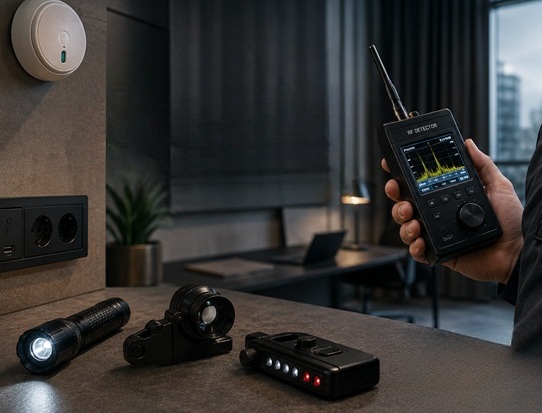
The idea that a private or professional space could be compromised by a surveillance device (microphone, camera, or tracking device) is a legitimate cause for concern. In the professional world, this field is known as TSCM (Technical Surveillance Counter-Measures). It involves methodically inspecting a location to ensure that no surveillance technology has been installed there (dust removal or “bug sweeping,” to use the jargon). Translated with DeepL.com (free version)
Whether in an office, a private home, a meeting room, or a vehicle, the potential discovery of a spy microphone, a hidden camera, or a GPS tracker can raise many concerns. Technical counter-surveillance (TSCM) operations allow for a systematic verification that no covert surveillance devices are present.
This article explains how to analyze a situation rationally and outlines the steps involved in a thorough review.
In what situations might you suspect the presence of a hidden microphone or camera?
Certain sensitive professional situations, family disputes, business conflicts, or contentious separations also lead some people to seek out potential illegal surveillance.
Suspicions often arise from signs that can be classified into two categories:
Physical signs
An object that wasn't there before (a new USB charger, a clock, a smoke detector), unusual dust marks near an electrical outlet, or a piece of furniture that has been moved slightly.
Contextual cues
Personal or professional information that appears to be known to third parties, or a particularly tense situation (conflict, separation, business dispute).
In most cases, these signs are not sufficient to confirm the need for monitoring, but they do provide a basis for technical consideration.
How do modern spying or surveillance devices work?
Current technologies make it possible to hide microphones or cameras in everyday objects: USB chargers, alarm clocks, smoke detectors, power strips, smart devices, or electronic equipment.
For a device to monitor a space, it generally needs three things:
- Power: A battery or a connection to the electrical outlet (a plug, a lamp).
- A sensor: A small microphone for sound or a tiny lens for images.
- A way to transmit: The device must send the information, often via Wi-Fi, Bluetooth, radio waves, or the mobile network (SIM card).
The analysis therefore involves looking for these three elements in the environment.
How can we objectively assess surveillance risk?
Assess the situation calmly; it’s important not to let worry get the better of you. You can assess the risk logically:
- Low risk: If no material changes are visible and no information has been leaked.
- Potential risk: If unknown objects have appeared and outsiders have gained access to the premises.
- Credible risk: If very specific details about your private life or business affairs become known to third parties without a logical explanation.
How can you detect a hidden microphone or camera?
A professional audit is not based on gadgets, but on precise methods:
Physical inspection of the premises
This is the most important step. We carefully examine every object, every outlet, and every nook and cranny.
Radio frequency analysis
We use devices that detect the invisible signals sent by Wi-Fi microphones or cameras.
Optical detection of hidden cameras
We're looking for reflections from camera lenses, even if the cameras are turned off or very small.
Electronic detection of concealed components
Some tools can detect electronic components hidden inside walls or furniture, even if they are not functioning at the time of the inspection.
Why are false alarms so common?
Mobile apps that claim to detect hidden cameras or spy microphones regularly produce false positives and are no substitute for a professional technical analysis.
It is reassuring to know that many suspicions are not confirmed. Modern technologies often produce phenomena that resemble espionage but are completely normal:
- Connected devices: A smart speaker or a modern TV naturally emits signals.
- Neighboring Networks: Your neighbors' Wi-Fi signals may appear very strong at your home, but this does not necessarily mean you are being monitored.
- Interference: Crackling or echoes on a phone line are often caused by technical issues on the service provider’s end, not by eavesdropping.
The importance of technical verification
In certain situations, the lack of a clear response to unusual events can gradually create a climate of persistent doubt. A data leak, an unknown object, or a technical issue that’s misinterpreted can lead people to associate certain everyday occurrences with potential surveillance. Over time, this accumulation of suspicions can create a state of hypervigilance, where every connected device, background noise, or network anomaly becomes a source of concern, and paranoia sets in.
In this context, the goal of a TSCM operation is not to confirm a suspicion at all costs, but to provide a technical, rational, and verifiable assessment of the situation. A methodical investigation to resolve doubts makes it possible either to identify a genuine anomaly or to rule out erroneous interpretations based on concrete evidence.
The main benefit of this approach is that it helps us move beyond a mindset of constant uncertainty by grounding our analysis in technical and factual observations, whether in a personal or professional context.
When should you hire a TSCM specialist?
Specialized intervention may be considered when a person observes several consistent indicators: unauthorized access to a facility, repeated leaks of confidential information, a sensitive conflict situation, or the discovery of a suspicious object.
In any case, the goal is not to confirm a hypothesis but to obtain a technical answer based on verifiable facts.
Things to keep in mind
The detection of surveillance devices is a rigorous process aimed first and foremost at restoring the truth. Whether the investigation confirms the presence of a device or definitively rules out any doubt, the goal is to resolve the uncertainty.
A methodical and evidence-based approach is the best way to regain control of your environment and protect your privacy.
Our team of specialists is here to help if you have any concerns about possible surveillance. A technical review can provide factual and objective answers.
Whether or not it reveals the presence of a surveillance device, the goal remains the same: to eliminate uncertainty and regain control of one’s environment.
FAQ about hidden microphones and cameras
Some apps claim to detect hidden cameras, but their reliability is limited. A professional check relies on a physical inspection and specialized equipment.
The presence of a hidden microphone generally cannot be confirmed with the naked eye. A technical inspection can be used to look for power sources, electronic components, and transmission signals.
These devices can sometimes detect certain devices, but they also generate many false alarms. They are no substitute for a systematic counter-surveillance approach.
Yes. Some GPS trackers are designed to be hidden on a vehicle and transmit its location remotely. A specific inspection can be conducted to check for their presence.